
Conhecimento Fratar
May 4-8, 2020, Aimsun Next Training Course, Online
Publicado
AssuntoTreinamentos Aimsun
Aimsun Next Training Course
May 4-8, Online
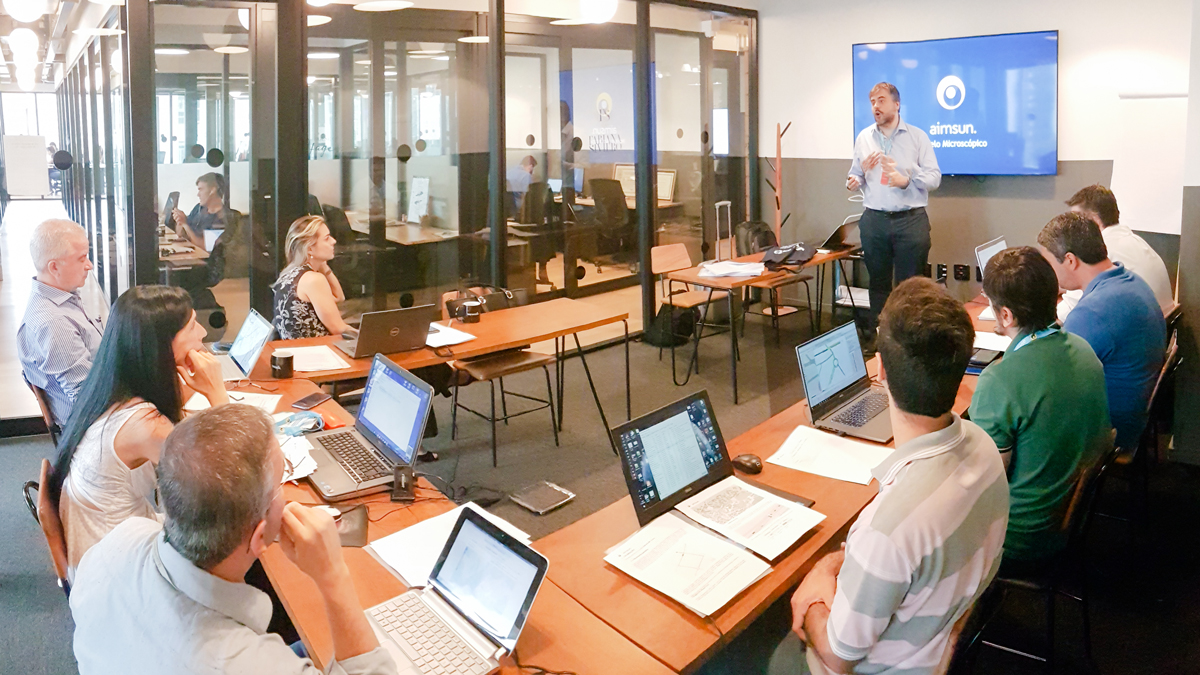
Due to Coronavirus restrictions, this is a remote training course that you can take from home via video conferencing.
Course language: English
Time: Your online tutor is based in London so the course will start at 9am GMT and end at 5pm GMT.
Breaks: There are mid-morning and mid-afternoon breaks plus an hour for lunch. Total teaching time is 7.5 hours.
Platform: We use Zoom or Google Meet for most of our online classes. If you have a software or security issue, please let us know and we will accommodate your needs.
How to install our software: Once you have signed up, we will send you two-step installation instructions for a temporary training license of Aimsun Next software. Please start this process 48 hours before the course starts to allow time for trouble shooting.
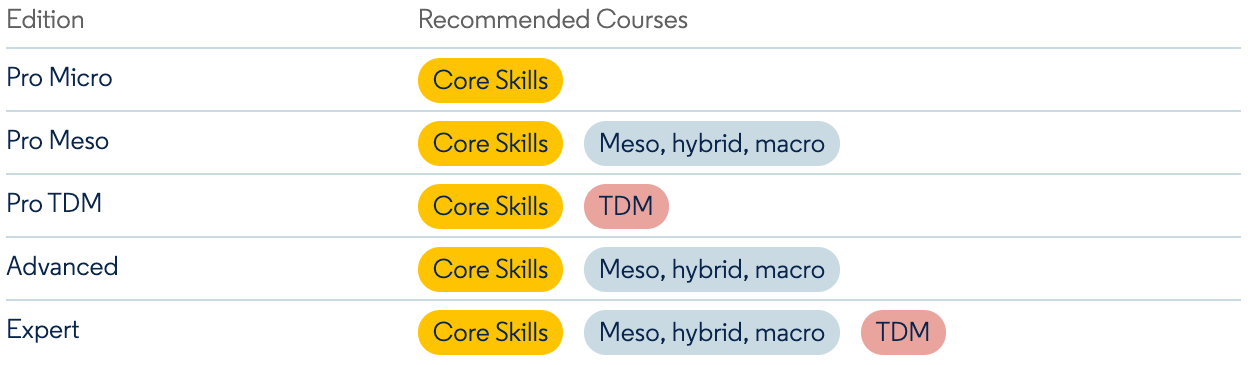
These 5 days of training cover all the skills you’ll need for using all editions of Aimsun Next. Choose the course or courses that match your edition, using the table below to guide you.
Courses
Afternoon session: 14:00–17:30 (including a 15-min break)
May 4-6
Our most popular training course, this is a thorough introduction to the fundamentals of building a model in Aimsun Next, with a focus on simulation at the microscopic level.
This course will take you all the way through the workflow of a typical project, from editing to traffic management, scenarios, outputs and calibration. There are hands-on exercises every step of the way to make sure you have mastered the basic concepts and you should finish this course ready to start experimenting with Aimsun Next software.
Day 1
Editing exercises
Geometry
Signal plans
Public transport
Traffic demand
Managing scenarios
Dynamic scenarios, experiments and replications
Attribute overrides and geometry configurations
Day 2
Outputs
Output calculation
Time series, thematic maps
Scenario comparison
Dynamic traffic assignment
Cost functions
Stochastic route choice algorithm and parameters
Dynamic user equilibrium algorithm and parameters
Combining paths
Day 3
Microscopic network loading
Microscopic vehicle behavior
Calibration of a microscopic model
Traffic management
Traffic management actions
Modeling incidents and mitigation strategies
Modeling turn restrictions, reversible lanes, and other scheduled events
May 7
This course zooms out from microscopic simulation to look at larger scale modeling. You’ll learn about the event-based mesoscopic model and how to combine it with a more detailed time-sliced microsimulator.
Then you’ll get to experiment with static macroscopic modelling, which is often used as a preliminary step to dynamic modeling to extract the demand of a subarea from a regional model, to adjust and time-slice it, and to get an initial set of paths to warm-start dynamic assignment.
Day 1
Mesoscopic network loading
Mesoscopic vehicle behavior
Calibration of a mesoscopic model
Hybrid microscopic-mesoscopic simulation
Macroscopic modeling
Static traffic assignment
Traversal demand calculation
Demand adjustment
May 8
The Travel Demand Modeling course covers the traditional four-step modeling process of trip generation, trip distribution, mode choice, and trip assignment.
You should finish this course with an understanding of the role of travel forecasting within transportation planning and of the principles of each of the four modeling steps. You’ll be able to demonstrate how input data is used, and interpret the outputs from each step.
Day 1
Travel Demand Modeling – the four-step model
Trip generation
Trip distribution
Modal split
Static public transport assignment
Registration
Maximum class sizes apply.
The post May 4-8, 2020, Aimsun Next Training Course, Online appeared first on Aimsun.