
Conhecimento Fratar
April 27-29, 2022, The 18th ITS Asia Pacific Forum
Publicado
AssuntoEventos Aimsun
April 27-29, 2022 | Chengdu, China
The 18th ITS Asia Pacific Forum

Initiated by ITS Asia-Pacific, the Forum has become the most prestigious ITS event in the Asia-Pacific region. With the theme of “ITS Driving for a Better Life”, the 18th Forum will bring together ITS practitioners to exchange ideas and initiate dialogues on how to provide ITS solutions to advance into a more livable, smarter and greener life. It is intended to advance the level of coordination and collaboration across the industry, thereby contributing to the actualization of ITS developments in social life.
Aimsun paper
Predicting and comparing traffic management response plans, to mitigate tail pipe emissions in real time.
Abstract
The Network Emissions / Vehicle Flow Management Adjustment project (NEVFMA) was a proof-of-concept project awarded by Innovate UK, on behalf of National Highways, to a consortium of EarthSense, Yunex Traffic (formally Siemens Mobility) and Oxfordshire County Council, led by Aimsun. The project focussed on the County of Oxfordshire, with an area of interest covering the strategic road network, the A34 motorway including the M40 Junctions 8 and 9. The aim of the project was to integrate emerging technology to holistically balance strategies to enhance public spaces, with response plans aimed at improving network capacity to deliver better air quality across regional and strategic networks.
The project used simulation modelling to estimate the impact of traffic on air quality, using traffic data provided by the local authority along with an emissions and dispersion model, and benchmark this model with ground truth measurements from state of art Air Quality monitoring devices installed in vehicles and on street infrastructure. The model created short term and medium-term predictions (up to 1 hour) for the Air Quality in the regions allowing for tactics to be established that control centres can deploy, modelling their implications, and establishing KPIs that highways authorities and traffic management centres can use to evaluate the effectiveness of AQ-aimed interventions.
Due to the ongoing impact of Covid-19, the Oxfordshire County Council highways team were unable to code the developed test response plans into UTMC. To counter this, the best comparative testing that could be provided was in the form of analysis of predictions and ground truth where possible. In line with National Highways aspirations for the project, region 13 was monitored in these tests by averaging traffic detection points on the A34 and Botley Road. The Zephyr 64 sensor was nearest and used for air quality ground truth. Over the test period, an hourly mean threshold of >40 μg/m3 NO2 was exceeded in 59% of morning, and 55% of evening peaks.
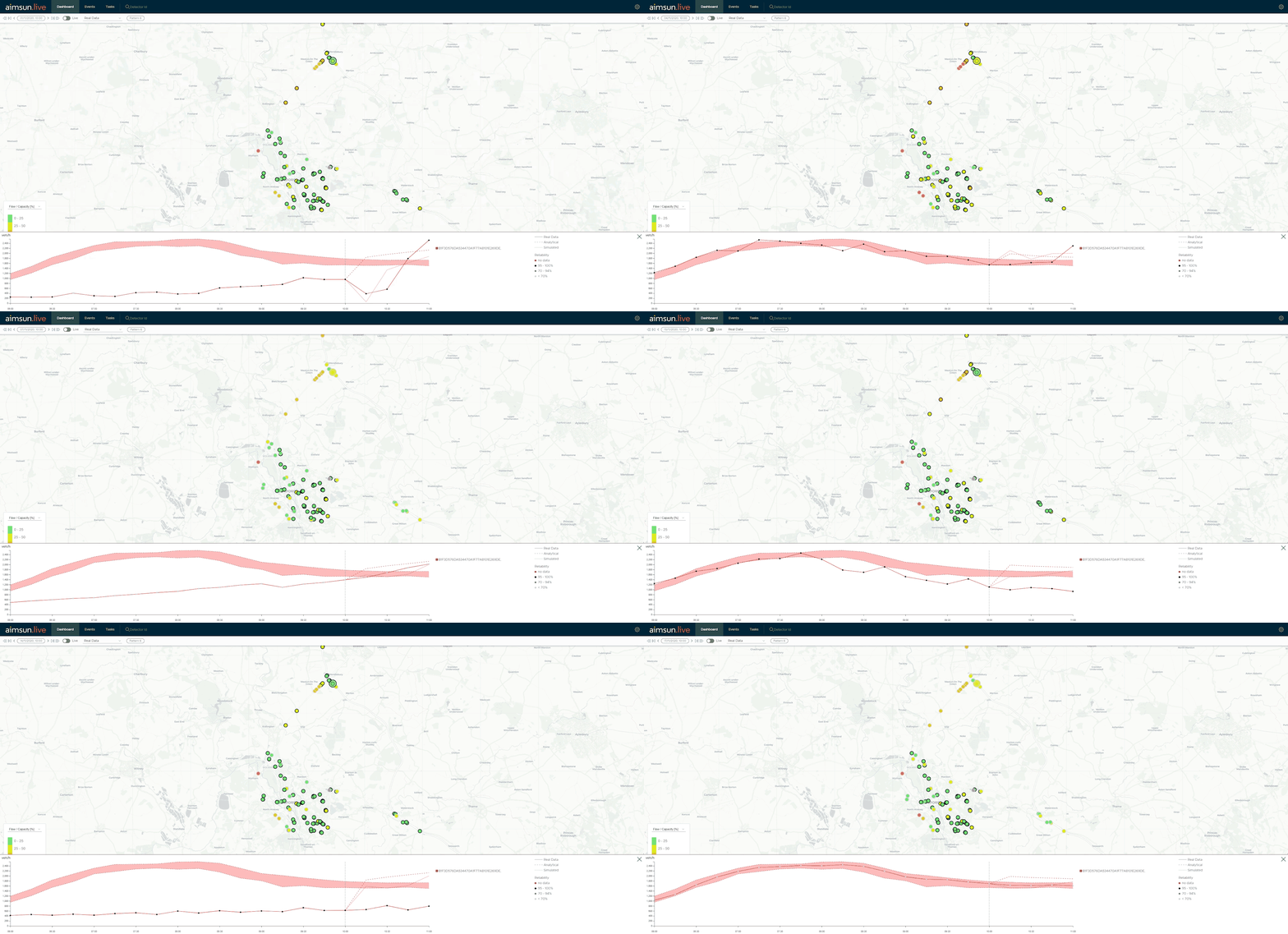
To trial the system, the response plan evaluation module was run at 08:15 or at 17:15, triggering a ‘do nothing’ and three alternative response plans to mitigate air quality issues.
The results demonstrate the value of the NEVFMA system – it reacted well to traffic and generated good predictions particularly in the morning, demonstrating the system could provide reliable short-term predictions and that there was good reason to deploy, as every day different response plans could help in different ways, depending on traffic and meteorological conditions. The trial period showed that all response plans were generated taking account of 2019 average conditions, and that employing the right response plan could give up to 7-8% benefit, while the wrong response plan could cost a 14-15% disbenefit – but right and wrong being entirely dependent on day conditions. In 18 trialled days, the response plans could make a modelled improvement between 65% (morning peak) and 54% (evening peak).
The post April 27-29, 2022, The 18th ITS Asia Pacific Forum appeared first on Aimsun.